
How to Get Started with Robotics in 2026 (Without Getting Overwhelmed)
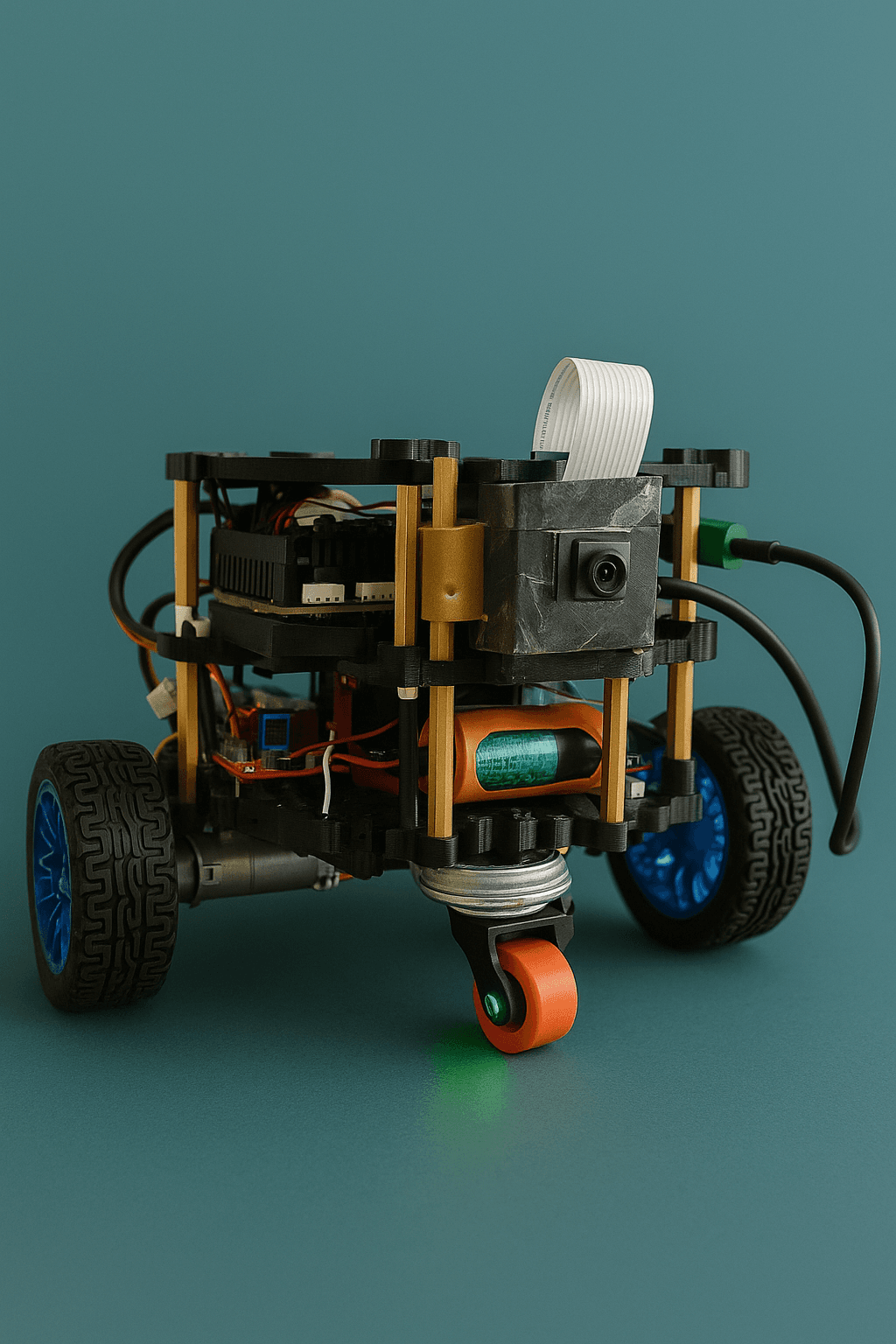
Every few weeks I get some version of the same message: "I want to get into robotics, where do I even start?"
And almost every time, the person asking has already done a lot of "starting." They've got a YouTube robotics playlist open. A college robotics syllabus PDF downloaded. Maybe a "Complete Robotics Roadmap 2026" infographic saved somewhere, with forty boxes on it — kinematics, control theory, embedded systems, ROS 2, computer vision, linear algebra — and an arrow connecting all of them before a robot ever shows up.
By the time they've read all that, they haven't built anything. They've just gotten more convinced that robotics is too big to start.
Note: You don't learn robotics by mastering every topic first. You learn robotics by building a robot — and letting that robot force the topics on you, one at a time, in the order you actually need them.
Why the "Learn Everything First" Approach Doesn't Work
Robotics is genuinely multidisciplinary. Mechanical design, electronics, embedded firmware, control systems, perception, planning, AI — it's not one subject, it's an entire stack of subjects stacked on top of each other.
That's exactly why "I'll learn it all first, then build" doesn't work. Nobody learns an entire stack in the abstract and then successfully applies it. You'd need years before you touched real hardware, and most people lose the curiosity that got them interested in robotics somewhere around month four of pure theory.
I've watched this happen to a lot of smart, motivated people. Not because they lacked ability — because they were solving the wrong problem. They were trying to learn a subject, when what actually teaches you robotics is trying to solve a robot.
[Illustration placeholder — split diagram: left side shows a tangled web of theory topics leading nowhere; right side shows one small robot at the center with a short list of skills radiating out from it.]
The Shift: Choose a Robot, Then Learn Backward From It
Instead of "I'll learn everything," the useful question is much smaller:
"What robot do I want to build?"
Say your dream project is an autonomous mobile robot (AMR) — something that can move through a room on its own. Your thinking shouldn't start with "I need to learn ROS 2, SLAM, and Nav2." It should start with: "I want to build an AMR. What's the first thing I actually need?"
Probably CAD — you need a body for the robot to exist in the first place. So you learn just enough CAD to design that body.
Then: "What's next?" Probably a way to write software for it. So you learn just enough ROS 2 to get a node talking to a motor.
Need the robot to know where it is in a room? Now SLAM has a reason to exist for you — you learn it because your robot is lost, not because a syllabus said so.
Need it to hold its position once it knows the map? That's when localization (AMCL) actually means something.
Need it to move from A to B without hitting the couch? Now Nav2 isn't an abstract framework, it's the thing standing between your robot and the wall.
This is exactly how I built the docking robot that MechaMind Labs still uses as our reference AMR.
I didn't sit down and "learn SLAM" as a subject one weekend. I learned exactly the SLAM I needed the day my robot couldn't reliably find its way back to its charging dock — and not a page more than that, until the next problem showed up. That's the whole method. Every topic becomes memorable because it's solving something in front of you, not something on a slide.
[Illustration placeholder — a real AMR: chassis, sensors, and onboard compute labeled simply, showing how each hardware piece maps to a software concept.]
Is Arduino Enough to Start Robotics?
Arduino is a genuinely good tool. It's cheap, well-documented, and a fine way to understand how code talks to the physical world — motors, sensors, LEDs, switches.
Where people get stuck is spending years there. Blinking an LED, then a slightly fancier LED pattern, then a line-follower, then another line-follower — without ever pointing that skill at a real robot project that pushes past it.
Note: Arduino isn't the problem. Stopping there is. Treat it as one small, useful part of the stack — the part that handles talking to motors and sensors — and let your actual robot project decide when you need to move beyond it (usually when you need more compute, more sensors running at once, or a proper operating system underneath, which is where something like ROS 2 enters).
A Practical Robotics Roadmap (Not a Syllabus — a Build Order)
This isn't a list of things to study in sequence. It's the order problems tend to show up in, once you've picked a robot to build.
[Illustration placeholder — this roadmap rendered as a clean vertical diagram with one icon per stage: Dream Robot → Understand the Problem → CAD → Simulation → ROS 2 → Robot Model (URDF) → RViz → Gazebo → Motion → Perception → Navigation / Manipulation → Hardware → Testing → Iteration.]
Stage | What It Actually Solves |
|---|---|
Dream Robot | Gives every later decision a reason to exist |
Understand the Problem | Defines what the robot must sense, decide, and do |
CAD | Gives the robot a body to hold its parts |
Simulation | Lets you test ideas before spending on hardware |
ROS 2 | Lets sensors, motors, and logic talk to each other |
Robot Model (URDF) | Describes the robot's structure so software can reason about it |
RViz | Shows what the robot 'thinks' is happening |
Gazebo | Lets the robot drive, fall, and fail safely in physics |
Motion | Gets the robot moving the way you actually commanded |
Perception | Gives the robot a way to sense its surroundings |
Navigation / Manipulation | Decides what to do now — move, or manipulate |
Hardware | Where simulation meets real motors and power draw |
Testing | Reveals where the real build breaks |
Iteration | Fixes the actual thing that broke, then goes again |
If you want to see the first two stages of that build order in action — ROS 2 fundamentals, explained from zero — this is a good place to start:
Note: Prefer to learn by reading code? Mastering the Basics of ROS2 with TurtleSim on our GitHub is genuinely the right first repo if you have zero ROS 2 experience. Once that's done, Joystick Module Integration with ROS2 is a good second step. If your dream robot is a manipulator instead, Franka Panda Color Sorting Robot is the equivalent starting point. If it flies instead of drives, see ROS2-PX4 Drone Teleoperation.
Common Mistakes Beginners Make
Trying to learn every topic before starting a single project.
Buying a pile of components before knowing exactly what the robot needs.
Watching tutorials back to back without building anything alongside them.
Waiting for the feeling of being "ready" — which doesn't arrive on its own.
Being afraid of getting something wrong, instead of expecting to and planning for it.
Thinking robotics is only coding (it's mechanical, electrical, and software, all at once).
Thinking robotics is only Arduino (it's one useful layer, not the whole stack).
Learning mathematics in the abstract instead of learning the specific math a real problem is asking for.
The Actual Philosophy
Build a real robot first. Then extract everything worth learning from the process of building it.
Not "learn robotics, then build a robot." The order is reversed, and that reversal is the whole difference between people who finish a robot and people who accumulate playlists.
This is also, honestly, just how engineering works past the beginner stage. Nobody at a robotics company sits down and "learns the whole stack" before shipping — they take on a real problem and learn exactly what it demands. Starting that way from day one just means you're training the actual skill, not a classroom version of it.
Frequently Asked Questions
Q: How do I start robotics?
A: Pick one specific robot you want to build — not a subject to study. Then work backward from that robot, learning only the skill each stage of the build actually requires.
Q: Is Arduino enough?
A: Arduino is a solid starting tool for understanding how code controls hardware, but it's one small layer of the robotics stack. Treat it as a stepping stone into a real robot project, not the destination.
Q: Should I learn Python first?
A: Basic Python is useful early on since most robotics tooling (including ROS 2) is Python-friendly, but you don't need to master it in isolation — you'll pick up exactly the Python you need as your robot project demands it.
Q: Should I learn ROS?
A: Yes, if you're building anything beyond a single-sensor, single-motor project — ROS 2 is the standard way modern robots coordinate sensors, motors, and logic. Learn it in the context of an actual robot, not as a standalone course.
Q: Which robot should I build first?
A: Something simple enough to finish in weeks, not months — a line-following robot, a basic teleoperated rig, or a small mobile robot in simulation before hardware. The goal of the first robot is finishing, not impressing anyone.
Q: Is robotics difficult?
A: It's multidisciplinary, which makes it feel harder than it is. Broken into one real project at a time, each individual piece is learnable — the difficulty mostly comes from trying to learn all of it at once, in the abstract.
Q: Do I need mathematics before robotics?
A: No. You need the specific math a specific problem demands — basic trigonometry for motion, some linear algebra once you're deeper into perception or manipulation — learned when the robot in front of you needs it, not as a prerequisite gate.
Q: Can I learn robotics without a degree?
A: Yes. A degree can help with fundamentals and access, but a portfolio of real, working robots you built and can explain is what actually demonstrates capability — to yourself and to anyone hiring.
Ready to Build Beyond the Basics?
If the build-first approach in this article clicked for you, that's exactly the philosophy behind our Autonomous Mobile Robot Mastery track — CAD, simulation, ROS 2, SLAM, and Nav2, learned in the order a real robot actually demands them, with mentorship along the way.
Explore Autonomous Mobile Robot Mastery →
Not ready to commit yet? Start with the Free Library instead. Building a robotic arm instead of a mobile robot? Industrial Robotic Arm Mastery follows the same build-first order.
Comments
Comments are coming soon. Meanwhile, share this post with fellow builders.
Subscribe to MechaMind Labs
Get robotics tutorials, track updates, and builder stories in your inbox.
Stay Ahead
Get robotics engineering updates, new learning tracks, free workshops, project releases, and builder opportunities.